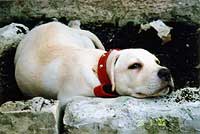
Have you ever wondered what your dog does when you are not at home? Does Poochie quietly wander the garden, sniffing at the daisies, rolling in the sun, generally behaving in a content and happy manner?
Or is it exactly the opposite? Perhaps ‘Paranoid Poochie’ may better describe your dog’s actions when you are at work.
If your dog is a destructive, barking, howling, escaping marauding mutt when you are away, Pooch could be suffering from a separation anxiety – a very common problem.
What causes separation anxiety?
If your dog has a separation anxiety, it’s because your dog is extremely attached to you. In fact, it’s over-dependant. Its over-dependance is a by-product of the fact that dogs are pack animals and prefer to live in a social grouping or a pack. Those of us who love our dogs dearly cause an overdependence in our dogs by being too devoted to them. They are content and happy when you are home but what a contrast when you leave to go to work or even to go to bed at night. Then your dog is forced to lead a life of isolation and that’s when the stress and the anxiety are at their worst.
However, the anxiety starts long before this. Think about your morning routine. The alarm goes at 6am. Alarms are very noisy and dogs have sensitive hearing. This heralds the beginning of the end for your pooch. Consider the other sounds that occur in exactly the same sequence each morning – the beeping of the microwave, the soft padding of your bare feet followed by the thunderous ‘clumpclump’ of your work shoes, and then the volcanic eruption of noise that occurs at the very time you leave. Then comes the mechanical monster, the car, roaring up the driveway giving the definitive last message, as loud as can be, that you are now gone.
Consider too, the odours of the morning. Now, with a sense of smell at least one thousand times more sensitive than ours, smells are a major part of a dog’s life. Look at the messages you give each work morning – the shampoos, deodorants, and perfumes you use, the smell of your morning coffee, even the smell of your leather work shoes. Very few of these odours occur on the weekend when you are not going out.
If that’s not enough, dogs are also very adept at picking their owner’s moods. If you are anything like me, you’re always anxious in the mornings trying to beat the merciless clock. Tension mounts as your departure time creeps unsympathetically closer and the Pooch is watching it all, absorbing all this stressful input, day in and day out.
How can you tell if a dog has separation anxiety?
Compare Pooch with the following list of ten key signs to see your dog qualifies as a Paranoid Poochie with a Separation Anxiety:
- When you are preparing to leave, does Pooch shadow you around the house, never letting you out of its sight?
- When you are leaving, is your dog unhappy and morose or does it have that ‘You’re going to leave me again, you mean, uncaring sod’ look? Does it block your access to the front door or is it even growling at you when you try to open the door to leave?
- Does your dog whine, yap or bark as you are leaving?
- When you return, does Pooch go over-the-top with the joy of seeing you – barking, whining, jumping up and overtly attention seeking?
- During the day on its own, is your dog destructive? Does it dig holes, pull washing from the line, rip up your sprinkler system, pull plants out of the garden beds, destroy garden furniture or scratch and claw the back door of the house trying to get in?
- Do your neighbours complain about excessive barking or howling when you are away or have you received a ‘poison pen letter’ in the letter box? Perhaps the Council has paid a visit and has wagged an accusing finger about excessive barking!
- What about other strange behaviours when you are about to leave? Does your dog show physiological signs of stress such as trembling, shaking, excessive salivation, drooling or hyperventilation?
- Is your dog mutilating itself when you’re away by obsessively licking or chewing its paws or the upper parts of its foreleg. This can cause a gradually enlarging lesion called an Acral Lick Dermatitis. They look ugly and can be difficult to control.
- Does your Pooch try to escape by chewing at fence palings or exit gates or has it actually escaped over or under your fence? Have you been chasing your own tail trying to fix the fence because as soon as one hole is patched, Paranoid Poochie finds another weak spot, and then another and another.
- And lastly, do you find excuses not to go out at night, just because you are concerned about the effect your absence will have on your Pooch?
If you are saying ‘yes’ to two or more of the signs in the first four above and one or more in the last six, your pooch is likely to have a separation anxiety. The more you say ‘yes’ to those in the last six, the worse your dog is, and the more serious is the problem.
So, what are the solutions?
Solving a Separation Anxiety involves giving attention to how you are going to get away from you pooch when you leave, what you are going to do for you pooch when you are away and how you are going to handle your dog’s attention seeking when you get home. In addition, most dogs with Separation Anxieties need to practice being away from their owners, while their owners are there so that they can progressively learn to cope with their owners’ future absence. Medications are often important for the severe cases.
In the morning when your leave your dog
Your repetitive morning routine tells your dog that you are going to leave. So shuffle the routine to confuse the pooch. For instance, reduce the effect of the noisy car and the screeching garage door by getting the car out of the garage and onto the street twenty minutes or so before you leave.
Employ the ‘Early Goodbyes’ principle. Put your dog in the yard about fifteen minutes before you leave the house. This is the time to say goodbye. Once you have done your Early Goodbyes you should then come inside, and, away from your dog’s beady eyes, get dressed in your work clothes and don your clumpy, noisy work shoes. This way Poochie doesn’t get steamed up by your ‘I’m almost ready to go now!’ signals.
Early Goodbyes won’t work unless you give your dog a rich and wonderful distraction such as a Kong Toy, a Roller Treat Ball or a frozen bone to carry the scallywag over the trauma of being put outside. When you are ready to leave, do so quietly and don’t go near Poochie. Softly sneak out the front door, creep into the car and leave with a minimum of commotion.
What to do for your dog during its day alone
Now you need to provide your dog with a wonderfully rich daytime environment with things that occur throughout the day to keep Poochie amused and happy. How do you do that if you are not home? A clam shell sandpit, with sand on one side and water on the other, is a joy for many a wayward woofer.
There are also many tricks that you can invent using the ‘Sneaky Leaking Bottle Timer’. For instance, fill a two or three-litre milk carton with water, puncture a small slit or hole in the base and place it up high on a shelf or similar with a ruler underneath. Put a tin can with some dry food on the end of the ruler. The water leaks though the hole, and when the bottle becomes too light, the ruler and tin will fall, scattering food. Poochie will then be delighted with the reward that is presented.
If you don’t want to give your dog any food, place a favourite toy on the ruler. The underlying principle is that, as the water leaks, the bottle lightens and acts as a timer. Invent your own delayed release rewards using the same principle.
Then there is the ‘Snakey Shakey Hose Surprise’. Secure a garden hose up high with a metre length hanging free. Connect the hose to a timer that turns it on after a few hours and off again later. Be sure you are complying with Council sprinkler times but you will certainly be complying with Poochie’s fun times when the hose becomes alive and shoots water around the back yard.
What to do as you arrive home
Another difficult part of the day is when you get home. Poochie will be delighted to see you. In fact Poochie will be over-delighted as your arrival signifies the end of its anxiety. However, by giving it attention for its compulsive attention-seeking behaviour, you are rewarding your dog’s anxiety. Fix this by putting your nose haughtily in the air and ignoring your Paranoid Poochie until it becomes calmer. This will only take a few minutes. Then give it attention as a reward for its return to calm behaviour.
At the times when you are home, weekends and evenings for instance, it is vital that you progressively teach Poochie that he or she can be away from you and enjoy it. Plan to get Poochie away from you for five to ten minutes three to four times a day and increase the time as success occurs. This can be a rocky trip so to make it work, place Poochie outside with an absorbing toy or reward of some type such as a Kong toy, a Roller Treat Ball or even a bone.
Trial Separations
Trial Separations will help to get your Poochie used to your absence while you are home so that it copes better when you are not home. The goal is to let Poochie know that he can be separated from you and enjoy it.
To do this, get a bone or pig’s ear or some other delectable reward and place Poochie in your bathroom or laundry or out the back door or on the deck. Leave Poochie to gnaw the bone for five minutes. Then open the door and let Poochie back with you. If this works you have the problem licked. All you now need to do is to gradually increase the time away from you until Poochie tolerates an hour or more away from you when you are home.
The next step is to do the same thing but leave the house for a little while, even if its for only five minutes. Some folk will lock the dog in the bathroom or put it out the back and go and water the front garden. Others go for a brief walk. Gradually build up the time of departure and the distance from your dog. When your dog is tolerating this degree of separation, start your normal work-leaving behaviours but on a weekend when you aren’t really going to work.
Medications
For some dogs, their anxiety is so severe that it becomes a self-fulfilling prophecy. For such dogs, anti-anxiety medications are a major bonus. The side effects are minimal and, where they are needed, they can help to speedily resolve serious anxiety disorders. Contact your veterinarian for more details.
By Dr Cam Day BVSc BSc MACVSc
Last updated on 17 November 2020