MENUMENU
  • Home
  • Our Team
  • Services & Facilities
    • Animal Critical Care
    • Animal Rehabilitation
    • Arthroscopy
    • Behavioural Consultations
    • Computed Tomography (CT)
    • Chemotherapy
    • Clinical Pathology
    • Dentistry
    • Desexing
    • Diagnostic Imaging
    • Dog Training
    • Endoscopy
    • Euthanasia
    • Microchipping & Registration
    • Nutrition
    • Pharmacy
    • Puppy Preschool
    • Senior Pet Health Checks
    • Spinal Surgery
    • Surgery
    • Pet Ultrasound
    • Vaccinations & Health Checks
  • Referrals
  • Information
    • After Hours Emergency Veterinary Service
    • Fees And Accounts
    • Memories
    • News And Articles
    • Your ultimate guide to pet care insurance
    • Pre & Post Op Handouts
    • Referral Form
    • Prescription or Product Refill Form
    • Useful Links
    • Your New Pet
    • Pet Portal
  • Careers
  • Contact Us
  • News
  • Book Online

Brunker Road Veterinary Centre

Quality vet care in Adamstown, Newcastle

02 4957 2269

Make an Appointment

278 Brunker Road, Adamstown NSW 2289
Mon-Fri: 8am-6:30pm, Sat: 8am-4pm
Sun + Pub Hols: Closed
You are here: Home / Articles / Cat and dog teeth anatomy explained

Cat and dog teeth anatomy explained

How many teeth should a dog or cat have? Do they have baby teeth? When do they lose them? These are some commonly asked questions, so here are the facts to answer all your dental dilemmas.

Types of teeth

Open wide! The four types of teeth in small animals are as follows: incisor, canine, premolar, and molar. Nature designed each to serve a special function.

Incisors

Incisors are named first, second and third (or central, intermediate, and lateral) based on their location in the mouth. There should be six incisors in the maxilla (upper jaw) and six in the mandible (lower jaw). Incisor teeth are used for shearing and grooming.

Canines

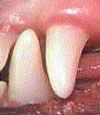
Normally, the lower canine should intersect the upper lateral incisor and upper canine.

Two large canine teeth are located in the mandible and two in the maxilla. The canines are designed to grasp and tear with great pressure.

Premolars and molars

Premolar teeth have sharp edges used for shearing. In the dog, there are four premolar teeth on either side of the upper and lower jaws. Dogs have four molars (2 on each side) in the upper jaw and six (3 on each side) in the lower. Molars have a flat surface used for grinding.

The cat has three premolars on each side of the upper jaw identified as second, third, and fourth; and two lower premolars on each side of the lower jaw, called third and fourth. Cats have one upper and lower molar on each side.
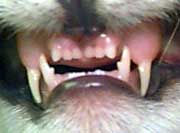
Normal cat teeth
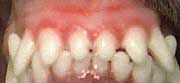
Normal incisors of a dog
The lower canine should intersect the upper lateral incisor and upper canine

Tooth eruption timeline

The primary or deciduous incisors erupt at 1 to 3 weeks of age while the primary canines erupt at 3 to 4 weeks. The remaining temporary premolars and molars should emerge by 10 weeks. The first premolar and all the molars erupt only as adult teeth. The remaining premolars, canines, and incisors appear in the oral cavity first as primary (temporary, deciduous, or baby) teeth. Secondary (adult) teeth usually appear at 4 months. Adult incisors appear first followed by canines, premolars, and molars. The complete adult dentition should be present in most breeds by 8 months of age.

Tooth composition

A tooth is composed of a portion above the gumline called the crown and a section below the gumline called the root. Enamel, the hardest mineralised tissue found in the body, covers the crown. Cementum, which is attached to the periodontal ligament, covers the root. Dentin, softer than enamel, makes up the bulk of the tooth. Inside, the pulp is composed of live tissue that contains nerves, blood vessels and lymphatics.

10 Tips For Brushing Your Pet’s Teeth

Dr Christine Hawke BSc(Vet)(Hons) BVSc(Hons) PhD MACVSc(Vet. Dentistry), founder of Sydney Pet Dentistry, recommends:

  1. Start toothbrushing as early in life as you can. It is easiest to teach young animals to have their teeth brushed, and prevention is better than cure.
  2. Make sure your pet is relaxed and comfortable – sitting in your lap, or being cuddled by another person.
  3. Make the initial sessions brief and positive. Don’t push the matter if your pet is getting upset. It often takes several weeks for your pet to allow you to use a toothbrush and toothpaste on them without protest.
  4. Start by using just your fingertips to rub along the teeth and gums. You can dip your finger into beef stock (dog) or tuna water (cat), or use a dab of a tasty pet toothpaste to make it more acceptable.
  5. Approach from the side and start with just a few teeth, gradually increasing the number of teeth as your pet gets used to it.
  6. Move up to using a facecloth or small finger brush, and finally onto a very soft bristle brush (which is needed to reach plaque hiding under the gumline).
  7. Choose a toothpaste designed for pets. Aside from the more appealing flavour, pet toothpaste is much safer for regular use. Human toothpaste is not designed to be swallowed, and pets are not good at the ‘rinse and spit’ method.
  8. When introducing toothpaste, put a small amount on your finger and let your pet taste it. Then press the paste down into the bristles of the toothbrush so your pet can’t just lick it off.
  9. Offer a reward at the end of the procedure, such as a walk or a game.
  10. Have your pet’s teeth examined regularly by your vet. Toothbrushing slows down dental disease, but does not prevent it completely. Humans who brush twice a day still need to have their teeth cleaned professionally, and so do our pets.

By Provet Resident Vet
Contributors: Dr Julia Adams BVSc, Dr Christine Hawke

Last updated on 20 December 2019

Back to Articles

Contact Us

Phone: 02 4957 2269
Fax: 02 4952 8666
Address: 278 Brunker Road, Adamstown NSW 2289

Our carpark entrance is via Victoria Street. We have a side path leading you from the carpark to our front entrance.

Location & Email Us

Make An Appointment

Opening Hours

Mon - Fri 8.00am - 6.30pm
Saturday 8.00am - 4.00pm
Sun + Pub Hols. Closed

Consultations are by appointment.
Emergency cases take priority.

After Hours Care

Newcastle Animal Emergency Centre (NAEC), at 4 Lang Road, Broadmeadow - (02) 4957 7106

Small Animal Specialist Hospital Tuggerah - (02) 4044 1781

Testimonials

  • 5
    Brunker Vet is outstanding. Our girl had Cruciate Ligament surgery and the vets along with the staff have been nothing short of amazing from the beginning. We still have a long recovery ahead however it gave me peace of mind knowing she was in such great hands❤️ Highly recommend. ❤️
    Google Review March 2026
  • 5
    We recently had our King Charles Cav in for luxating patella surgery. Brunker Road Vets have been so helpful in the aftercare process, and I couldn't recommend them enough for any of your pet needs!🙏
    Google Review August 2025
  • 5
    Brunker Road Vet is the best! I have been coming here for 3 months with my two kittens (Inky and Plop) and the team is just amazing. My cats and I receive the most thoughtful, compassionate and caring service every time. I am always treated with kindness and respect every time I visit, and I feel like a valued person! Special shout out to our vet, Dr Mcdougal, and Ash, for taking the time to answer as many questions as possible about my babies. I recommend everyone go here for their fur babies! You will be well taken care of 🥰🐈‍⬛🐈
    Google Review Jan 2026
  • I could not speak more highly of Brunker Road Vets. From the wonderful reception staff to the experienced vets and vet nurses, the care has been outstanding.
    My beautiful kelpie, Betty, has had a few health issues over the last couple of years and recently went through a pretty major surgery. Thank you so much to Sue for following her instincts and digging deeper when things just didn’t seem quite right. Because of that, they discovered a tumour on her spleen. Thank you to Lucy for successfully removing it and taking such incredible care of her. The level of compassion, professionalism and dedication shown to Betty has been exceptional. Nothing is ever too much trouble for this team, they take the time to explain everything clearly, and I’ve always felt completely informed about diagnoses, medications and care plans. We are incredibly lucky that her tumour is benign and that we get to spend more time with our beautiful girl. All of the staff at Brunker Road Vets have been extraordinary, and I’m so grateful to have such an amazing team caring for Betty.
    Google Review Dec 2025

Newsletter

Subscribe to our monthly email newsletter to get the latest news from Brunker Road Veterinary Centre.

Follow Us

Connect with Brunker Road Veterinary Centre on:

  • Facebook
  • Instagram
  • YouTube
  • Newsletter

Make an appointment

Book Online

Call us

02 4957 2269

Find Us

278 Brunker Road
Adamstown NSW 2289

Brunker Road Veterinary Centre

Address 278 Brunker Road
Adamstown, NSW 2289

Contact Us

Phone 02 4957 2269
Fax 02 4952 8666
Email Us
Book Online Pet Portal Leave a Review

Follow Us

  • Facebook
  • Instagram
  • YouTube
  • Newsletter

Latest News

  • Desexing Month in June 2026
  • Important Update: RSPCA Pet Insurance & Gap Only Claims
  • Health Alert: Protecting Your Dog Against the Newcastle Parvovirus Outbreak

Quick Links

  • Why Choose Us
  • Newcastle Puppy Preschool
  • Vet Referral Form
  • Privacy Policy
  • T&C’s

© 2026 Brunker Road Veterinary Centre · Online Presence by Petpack