The danger of ticks on pets
The Paralysis Tick and the Brown Dog Tick are the two most common ticks on dogs. However, it is the Paralysis Tick that is by far the most dangerous. It causes paralysis in a variety of forms but a ‘typical’ case starts with weakness of the hindquarters that progresses to total paralysis of all four legs. Other typical early signs include an altered bark or meow and vomiting. When the chest muscles and muscles of the throat become affected, the dog or cat is in serious trouble.
When a Paralysis Tick affects a pet, the pet often dies. Preventing tick paralysis is a much safer and cheaper alternative than treating the condition once it has occurred.
Where and when does tick paralysis occur?
The Paralysis Tick is found mostly along the eastern coast of Australia, but has been reported in Western Australia as well. It can also be found inland in suitable habitats. Ticks need humidity and mild weather to develop and will not survive and breed in cold climates. In northern parts of Australia paralysis ticks may be found all year round, while in southern areas the season goes from spring through to autumn.
Searching your pet for ticks
If you live in a tick-infested area, you should examine your dog or cat for ticks on a daily basis. If you have taken your pet for a walk through the bush or have been camping with your dog then examining it when you get back home is also a good idea. Don’t try to look for ticks, try to feel for them instead. Ticks are a lot easier to find if you rub your fingertips through your pet’s coat rather than if you try to look for them. In 70% of cases ticks are found in the head and neck region but it is important to search the entire dog (including inside ears, around eyes, under the collar, under lips, between toes, under the tail, chest, belly etc.)
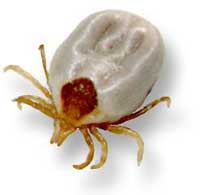
The ticks are often grey in colour and all of the legs are bunched towards the front of the tick, not spread along the side of the body.
There is still some debate on the best way to deal with a tick once you have located it. However, research has confirmed that it’s best to get the tick off the pet’s body as soon as possible. A device such as the Tick Twister is designed for this purpose and can be purchased from your veterinarian.
The next step is to take your pet to your veterinarian. This is vital, as the residue of the tick’s toxin under the skin can really cause a problem. Although the tick has been killed or removed, the animal can still become paralysed from this residue of poison. The poison is slowly absorbed and may cause paralysis hours or even a day or two later.
Stages of tick paralysis
- Dogs and cats can often lose control of their throat and voice box first. A strange meow or bark may be the first thing you notice.
- Regurgitation and vomiting is common.
- Hind leg weakness/paralysis is next.
- The weakness/paralysis rapidly ascends up the spine towards the head, with total paralysis occurring last. Laboured breathing and grunting is common at this stage.
Preventing tick paralysis
Tick infestations can be prevented although tick control is easier on dogs than on cats. Also, manufacturers are releasing new products onto the market regularly to make the job easier and more reliable.
There are several ways to minimise tick infestations.
- Firstly, there are specific tick collars for dogs that are available, such as the Kiltix Tick and Flea Collar, Seresto Flea and Tick Collar, Preventic 2 Month Tick Collar and Scalibor 3 Month Paralysis Tick Collar. Collars are not suitable for dogs that swim regularly.
- Bravecto (every 3 to 4 months) and Nexgard/Nexgard Spectra (monthly) chews are very convenient ways to protect your dog from fleas and ticks. These should be given to your dog all year.
- Advantix for dogs is a spot-on product that both repels and kills paralysis ticks when applied every 2 weeks (not every month). It is also effective against brown dog ticks, bush ticks, fleas, lice, mosquitoes and sandflies. Because it is water-safe, it is suitable for dogs that occasionally swim. Do not use on cats and separate your dog and any cats on the day of application.
- For cats and dogs, Frontline is a good choice. Frontline Plus top spot is effective for ticks on dogs if used every 2 weeks (not every month). Do not wash your dog 48 hours before or after application. Frontline Plus is not proven to control ticks in cats, so the use of Frontline Spray is advised.
- Frontline Spray is effective for ticks on dogs and cats if used every three weeks at the rate of 6mL/kg of bodyweight. If you find a tick on your pet, you can spray the product directly onto the tick to kill it but it may take some time to die, so removal of the tick is preferable.The Tick Twister is a plastic tool for removing ticks of any size from dogs or cats while keeping the tick’s mouth parts intact and avoiding further infection.
- Fido’s Flea Shampoo or Fido’s Fre-Itch Rinse is effective for ticks and fleas if the dog or cat is bathed in it every three days. These products are useful when your pet has been in a tick area and you want to kill off any hitchhiking ticks.
- Permoxin Insecticidal Spray and Rinse is also effective for ticks on dogs. It should be applied as a rinse every seven days, spongeing carefully around the dog’s face to ensure thorough coverage. It can be used as a spray daily for extra protection if exercising in bushy areas.
No one product is 100% effective so, in tick prone areas, it is essential that your pets be searched thoroughly every day for ticks.
Avoiding tick habitats as much as possible is also helpful. Ticks prefer bushy native terrain and long grass, where bandicoots (a natural host of the paralysis tick, along with wallabies, kangaroos, and other marsupials) reside. Danger areas also include overgrown gardens, composting areas, and shady patches under overhanging branches in overgrown recreational areas that are attractive to pets and their owners during the hot weather.
Don’t take chances with ticks. They are the most dangerous of parasites that can infest your pet and they kill. See your veterinarian and ask his or her advice on a safe tick control program for your pet.
By Dr Cam Day BVSc BSc MACVSc (Veterinary Behaviour)
Contributor: Provet Resident Vet
Last updated on 17 December 2019